
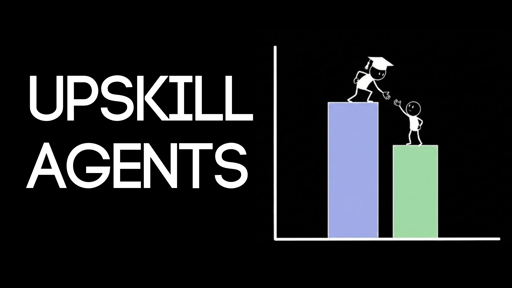
Everyone keeps saying the future is using high-capacity frontier models to systematically train and distill more efficient, low-cost models. And yeah, the pattern is clearly emerging. The basic loop looks like this. Expensive frontier models act as teachers through distillation, preference modeling, and synthetic data generation. Smaller cheaper models get deployed as the actual workers embedded in products, running on-device, fine-tuned for vertical use cases, powering agents. Then real-world usage data from those cheap models feeds back as new training signal for the expensive ones. Rinse and repeat. Hugging Face just published a piece on this called “Upskill” and it got me thinking about where the limits actually are. Part of why this is accelerating so fast is that knowledge transfer between models has gotten way easier recently. The tooling around distillation and synthetic data pipelines has matured to the point where this isn’t a research project anymore, it’s becoming a standard workflow. Which is exciting but also means everyone’s going to try it and most people will hit walls they didn’t expect. Because in theory this sounds clean. But I’m curious how far it goes in practice before somthing breaks. A few things I keep wondering about: First, what’s the most compelling real-world example of this actually changing unit economics? Not just “we distilled a model and it’s smaller” but like, meaningful shifts in inference cost, latency, or hardware requirements that actually changed what a product could do. Second, is there a ceiling? At what point does the cheap model just fail to faithfully inherit the capabilities of the teacher? There has to be a quality cliff somewhere. Where the student model looks fine on benchmarks but falls apart on the edge cases that actually matter in production. Has anyone hit that wall? Third, how does this shape the ecosystem long term? Are we heading toward a world with like 3-4 foundation teacher models and thousands of cheap specialized worker models underneath them? Or does it fragment differently? And the one I’m most curious about. For people actually shipping products right now, what’s the real tradeoff between “just call the big model via API” versus “invest weeks into training a small one”? Because the economics of that decision seem like they shift constantly as API prices drop and new models come out every few months. I’m especially interested in concrete failure modes. Like, you spent a month distilling a model and then the teacher model got a major update and your student was suddenly outdated. Or you hit review bottlenecks where nobody on the team could evaluate whether the distilled model was actually good enough. Or maintenance costs that nobody planned for. The “expensive trains cheap” paradigm makes logical sense. But the real question is where the practical breakpoints are. Curious what people in this sub are seeing in the wild. submitted by /u/hiclemi
Originally posted by u/hiclemi on r/ArtificialInteligence