
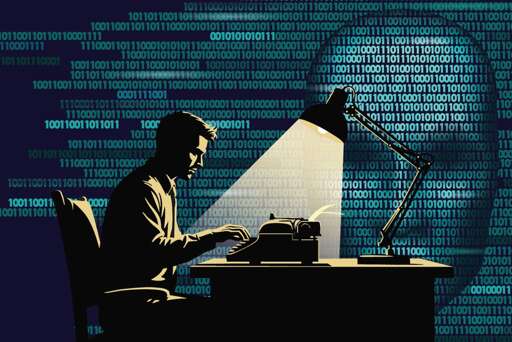
From Globe.com By Billy Baker I write to you from the year 2026, which history will record as the infancy of the age of artificial intelligence. This whole thing is just a few years old for us, but already we humans — do you still have humans? — are beginning to reckon with the genie we have let out of the bottle. I say “we,” but the truth is only a few people had anything to do with this decision, and I was not consulted. Nor have any of us been presented with the ability to opt out. Just so you don’t hate all of us. Here’s the funny thing: for generations, our novelists and filmmakers have explored this topic inside their brains. We still do that back here in 2026. And each one of them came to the same conclusion about what would happen after we uncork the bottle. It ends poorly for humans. The plots are so similar as to be a bit tired. Humans create machines. Humans give machines intelligence. Machines take over humans. Humans must defeat machines. We’re still at the beginning of this story back here, and I can’t begin to imagine what chapter you’re on when you read this. But here in 2026, it is the moment where the fear has moved from existential to real, and sticking our fingers in our ears and saying “Nah, nah, nah, nah, I can’t hear you” will not keep us from being swept away in the tsunami. I certainly tried; I even used my thumbs. Before I go any further, allow me to describe what life is like in 2026, as far as it relates to technology. It’s been roughly two decades since the smartphone entered our world and quickly ended the age of alone, that 300,000ish-year-era where modern Homo sapiens had only their brains to survive out in the world. I was there for the final three decades of this run, but I struggle to remember life back then. I wanna say we talked to other humans if we didn’t know something, but that sounds made-up. Having the internet in our pocket was supposed to be the true dawn of the “information age” that would “connect” the world. I can’t even begin to tell you how much that backfired. What it really did was steal one of the two most sacred things we humans possess: our attention. Capturing our “eyeballs” became the basis of our economy. Do you still have eyeballs? Now AI is coming for our second sacred thing: our voice. This realization recently clobbered me over the head after I wrote a jokey story about the perils of driving on a road called Route 1. We still (mostly) drive our own cars, and this particular stretch is a ludicrous one to navigate. So I had a little fun with the absurdity and published the article in a newspaper (please ask your AI what that is). Many humans read it, and some started a thread about it on the internet, whose purpose was to accuse me of using AI to write the entire thing. The accusation barely bothered me, for I knew I’d written all those corny jokes myself. But what horrified me was the realization that I could no longer prove it. For when it comes to our creativity, we are nearing the point where we can no longer tell real from fake. We may already be past it, but how can we tell? Everything has an asterisk. Now that the fingers have been forced from my ears, the terror of AI has come flooding in. I sit here, in 2026, as the last generation of writers, artists, musicians, and all the other “creatives,” to have had the opportunity to put out a large volume of unquestionably clean work. But there is no upside, because I am the first generation to live through watching the AIs take all that work, “learn” from it, and be able to perform a horrifyingly accurate impersonation of my “voice.” “Who is Billy Baker?” I recently asked ChatGPT, the AI whose arrival, in late 2022, launched the AI epoch seemingly overnight. I can’t believe that was less than four years ago. ChatGPT went through some Billy Baker biography, told me a bit about my themes and writing style — the AI was seductive in its sycophancy — and then asked if I wanted it to show me one of my articles to break down my style in more detail. I, of course, said yes; who doesn’t want to be told they have a style? And the example it used was a four-paragraph piece about becoming a morning person. I read it. Then I read it again. I was 100 percent certain that I’d written it, because I’d 100 percent had the thoughts contained in it. But I couldn’t remember where it was from. This was no surprise, because I’m a few weeks from turning 50, and now spend much of my time walking into rooms and forgetting what I was there to get. Do you still have rooms? Then I scrolled back a bit and saw that ChatGPT had noted it was an example “in his style.” My brain had been outsourced to the cloud. “If you want,” ChatGPT wrote, “Give me a topic (something small and everyday), and I’ll write you a full Billy Baker-style column.” So I asked it to write this. Just kidding. Or am I? I rely on humor as a funny way to be serious, but this is not something small and everyday. This is the biggest self-inflicted threat of my lifetime. From here in 2026, we’ve somehow managed to survive for more than 80 years without our ever-warring governments destroying humanity with nuclear weapons. Yet in my soul — do you still have those? — the age of AI feels just as wobbly as the nuclear age, except the power is being placed in the hands of any moron with an internet connection. submitted by /u/bostonglobe
Originally posted by u/bostonglobe on r/ArtificialInteligence
You must log in or # to comment.