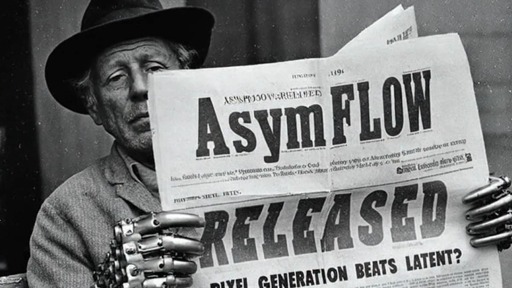
At some point the field quietly agreed that pixel space was too hard and moved on. Stable Diffusion, FLUX, every serious text-to-image model you've used in the last three years works in latent space. Instead of generating actual pixels directly, these models compress images into a smaller mathematical representation, do all the expensive work there, then decompress back to pixels at the end. It's faster, it's cheaper to train, and it made the current generation of image models possible. The cost is subtle but noticable. That compression step loses information. Fine textures, sharp edges, precise details, things that live at the pixel level get smoothed over in ways that latent models can never fully recover because by the time they're generating, those details are already gone. Researchers at Stanford just published a way around this. AsymFlow doesn't ask you to abandon your latent model or train a pixel model from scratch. It takes what you already have and converts it. And the result beats the latent model it started from.
Researchers at Stanford just published a way around this. AsymFlow doesn’t ask you to abandon your latent model or train a pixel model from scratch. It takes what you already have and converts it. And the result beats the latent model it started from.
submitted by
/u/techzexplore
Originally posted by u/techzexplore on r/ArtificialInteligence