
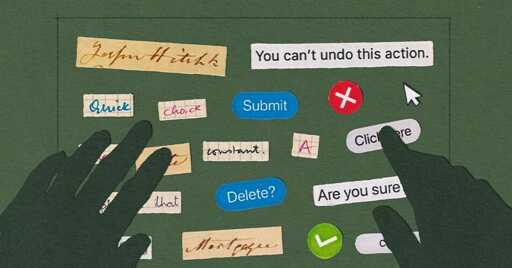
Opening paragraphs: In 1971, planes carrying millions of financial and administrative records—order forms, charge slips, telephone system files, oil well logs—began arriving at Phoenix’s Sky Harbor airport. These paper records were then driven twenty-five minutes south to the Gila River Indian Reservation, home to the Pima and Maricopa nations, where, in the cafeteria of the reservation’s arts and craft center, dozens of employees, mostly Indigenous women, retyped them into computer-readable form. Few remember it anymore, but that cafeteria was the front line of the digital revolution. In the 1960s, computers were sweeping corporate America, promising more efficient processing of insurance claims and retail sales, but the transition presented a massive logistical problem: Most companies still conducted their business on paper. If they wanted these expensive new devices to save time and cut costs, companies first needed to digitize everything: invoices, receipts, ticket sales, job applications, credit reports, letters, phone messages, and handwritten notes. The scale of paper records was staggering. The credit bureau TransUnion, for instance, needed to transpose fourteen million credit records into computer-readable form. At the federal level, the U.S. Treasury had to digitize four hundred million records per year. All that work would require human labor—a lot of it. Many American businesses couldn’t afford to hire these new workers directly, so they decided to subcontract the labor out, creating a kind of geographically dispersed, auxiliary workforce they rarely chose to acknowledge. The analytics firm Fair, Isaac and Company, which went on to develop the FICO credit score, placed at least one newspaper ad offering flexible, part-time data entry work to California housewives in the late 1960s, as the scholar Martha Poon has documented . These housewives, close to two hundred in all, picked up credit documents from Fair Isaac, and then, from their homes, parked cars, or laundromats translated payment records into a computer-readable form. submitted by /u/okokyaalright
Originally posted by u/okokyaalright on r/ArtificialInteligence
You must log in or # to comment.