
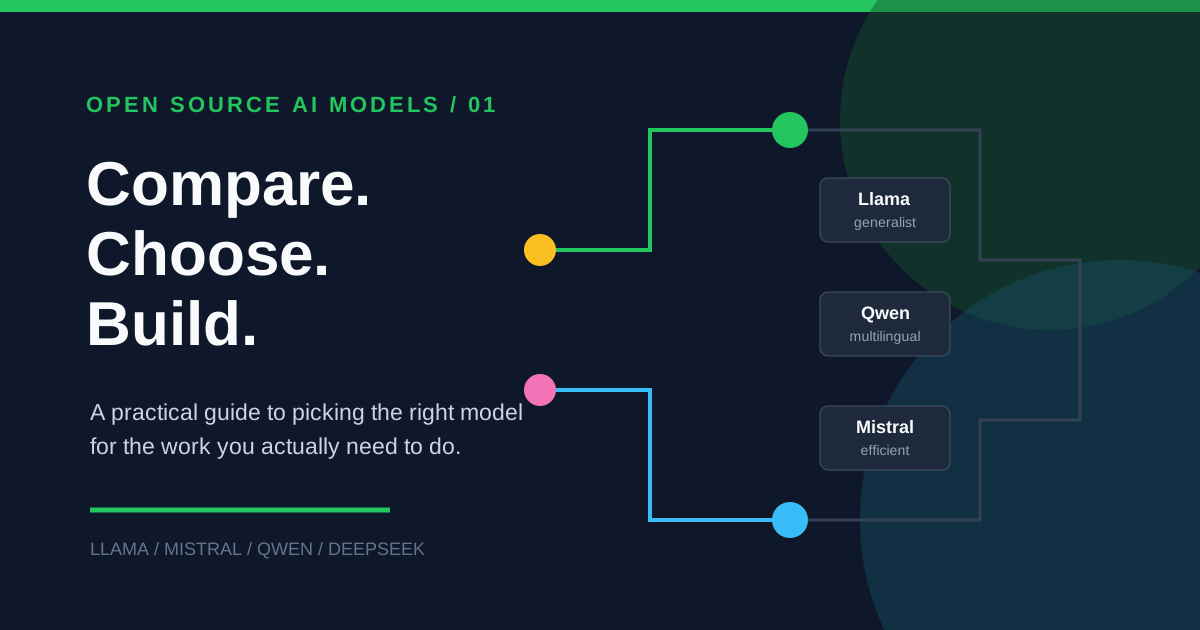
A while back, I shared a beginner-friendly guide here on setting up local AI in under 10 minutes using Ollama and LM Studio (thanks for the great feedback and discussion on that!). Once you get Ollama or LM Studio running, the immediate next problem hits you: Which model do you actually pull? There are dozens of open-source models out there, and benchmark leaderboards (MMLU, HumanEval, LMSYS) often don’t tell you how a model behaves for real day-to-day tasks or what fits on your hardware. I just wrote a deep dive on how to evaluate and pick between the major model families. Here is the tl;dr breakdown and decision framework:
- The 4 Major Model Families (And what they’re actually good at) Llama (Meta): The Reliable All-Rounder 8B : Great baseline for chat, instruction-following, and RAG. Fits on almost any modern laptop (MacBook / 16GB RAM). 70B : The sweet spot for complex reasoning, multi-step logic, and nuanced writing if you have the VRAM/hardware. Best for : General enterprise use, workflows needing predictable output, and safe commercial licensing. Mistral: Speed & Parameter Efficiency 7B / Nemo (12B) : Unbelievably fast and punchy. They squeeze incredible performance out of smaller parameter counts. Best for : Low-latency tasks, high-throughput pipelines, summaries, and cost-constrained deployments. Qwen (Alibaba): Multilingual & Deep Math/Reasoning Qwen 2.5 (7B, 14B, 32B, 72B) : Heavily underrated in western dev circles. Outperforms almost everyone in multilingual tasks, structured output, and heavy technical/math reasoning. Best for : Non-English workloads, complex data parsing, and structured JSON generation. DeepSeek: The Coding Specialists Coder / V2 / V3 : If you are doing code generation, code review, or dev tooling, DeepSeek models hit way above their weight class (a 6.7B or 14B DeepSeek often beats generic 13B/70B models at coding). Best for : Coding assistants, IDE integrations, and technical Q&A.
- The Quick Decision Rule Instead of obsessing over 0.5% benchmark differences, match your primary workload: Coding / Refactoring: DeepSeek-Coder (or Qwen-Coder ) General Chat / Summaries / RAG on modest hardware: Llama-3-8B or Mistral-7B Multilingual or Strict Structured Data (JSON/Function calling): Qwen-2.5-14B/32B Complex Multi-Step Logic / Nuanced Analysis: Llama-3-70B or Qwen-2.5-72B
- Quick Rule of Thumb for Sizing ~7B–8B models (4-bit quant): ~5–6 GB VRAM → Runs on M1/M2/M3 MacBook (16GB) or 8GB GPU. ~14B–32B models (4-bit quant): ~10–20 GB VRAM → Sweet spot on 24GB RTX 3090/4090 or Mac with 32GB+ RAM. ~70B models (4-bit quant): ~38–42 GB VRAM → Requires dual GPUs (2x RTX 3090) or Mac with 64GB+ unified memory. I’ve written a complete breakdown covering capability matrices, licensing considerations, and common pitfalls over on my blog: 🔗 Full article: Open Source AI Models: Comparing Llama, Mistral, Qwen, and DeepSeek - Which to Use (This is Part 1 of a 3-part series. Part 2 will cover hardware & quantization benchmarks, and Part 3 will cover production deployment architectures). Curious to hear from the community: What has been your go-to daily driver local model lately? submitted by /u/anant94
Originally posted by u/anant94 on r/ArtificialInteligence
You must log in or # to comment.