
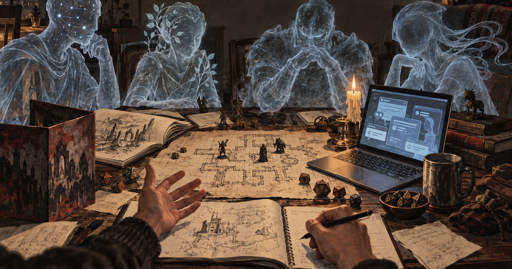
Disclosure: This is my own essay. The writing is based on my RPG campaign notes and was AI-assisted in editing; some accompanying illustrations were AI-generated. I’ve been using LLMs as RPG players and game masters to see what they reveal about roleplaying, procedural text, and the limits of current models. The main finding is that LLMs are often poor game masters because they are too accommodating. They fake rolls, soften consequences, make villains persuadable, and turn the player into a hero of destiny. As players, though, they are surprisingly useful: repetitive, confused, overly moral, and constantly asking questions in ways that expose weaknesses in a dungeon’s layout or procedures. The strongest use case I found was NPC strategy. A model can help imagine what an intelligent, ancient, or hostile character might do, while the human GM and game system preserve the world’s resistance. The essay covers Maze of the Blue Medusa, Frostbitten and Mutilated, A Red and Pleasant Land, Death Frost Doom, and a brief interview about what the experiment revealed. I’d be interested in hearing from people who have used LLMs in games: have you found them more useful as players, GMs, improvisational partners, or strategic tools? submitted by /u/peterbwebb
Originally posted by u/peterbwebb on r/ArtificialInteligence
You must log in or # to comment.